

"Can you just send me a price?" Most service firms hear that question and answer with a three week discovery cycle and a bespoke document. B2B service packaging is the alternative: it turns a custom scope of work into a small set of named offers, each with fixed scope, a stated outcome, and a published starting price. Buyers can compare it, forward it, and approve it without a seller in the room. Your delivery team gets a repeatable shape to staff against.
What makes B2B service packaging easy for buyers to understand?
A package reads clearly when a buyer can answer four questions in under a minute: what do I get, what changes in my business, what does it cost to start, and what do I have to do. B2B service packaging breaks down the moment any one of those answers needs a discovery call first.
That matters because the seller is barely in the room. Gartner's B2B buying journey research finds buyers spend roughly 17% of their total purchase time meeting with all potential suppliers combined, and only a fraction of that with any single rep. Forrester's B2B buyer research points the same direction: buyers want clear, relevant information that lets them make progress without being handled. HubSpot's research on B2B buying keeps surfacing the same two blockers, unclear pricing and vague product information.
So write the offer for the person reading it alone at 9pm. Name the package something a buyer would say out loud. State the outcome in their language, not your method. Give a starting price band or a plain statement of how price is set. List what is not included, because an honest exclusion builds more trust than a fuzzy inclusion. If you compete on being different rather than cheap, the package is where that difference becomes legible, which is the same argument behind B2B differentiation strategy.
How to define scope, outcomes, and delivery tiers
Start from delivery reality, not from a pricing page. Write down the three or four engagements your team has actually run more than twice, strip each one to the work that produced the result, and set a boundary where the effort stops being predictable. That boundary is your scope line, and everything else negotiates around it.
Then separate three things firms tend to blend: scope (the work), outcome (the change the buyer gets), and tier (how much of it). Tiers should differ by depth or breadth, never by how much care the client receives. A tier that reads as "we try harder at this price" teaches buyers to distrust the one below it. Harvard Business Review's work on buyer decision simplicity has long argued that reducing effort, not adding choice, is what moves people to commit.
Three tiers is usually enough. One Blue Ocean Solutions client, a managed-IT firm in Ohio we started working with in March 2026, replaced a single custom quote with three named tiers and cut proposal turnaround from nine days to one within the first quarter. Pricing logic belongs in the open, and the method matters more than the number, which is why B2B service packaging and value-based pricing for B2B services are really one decision. Define the handoff too: what happens in week one, who is accountable, and what the client supplies. Vague starts create exactly the churn risk covered in B2B client onboarding.
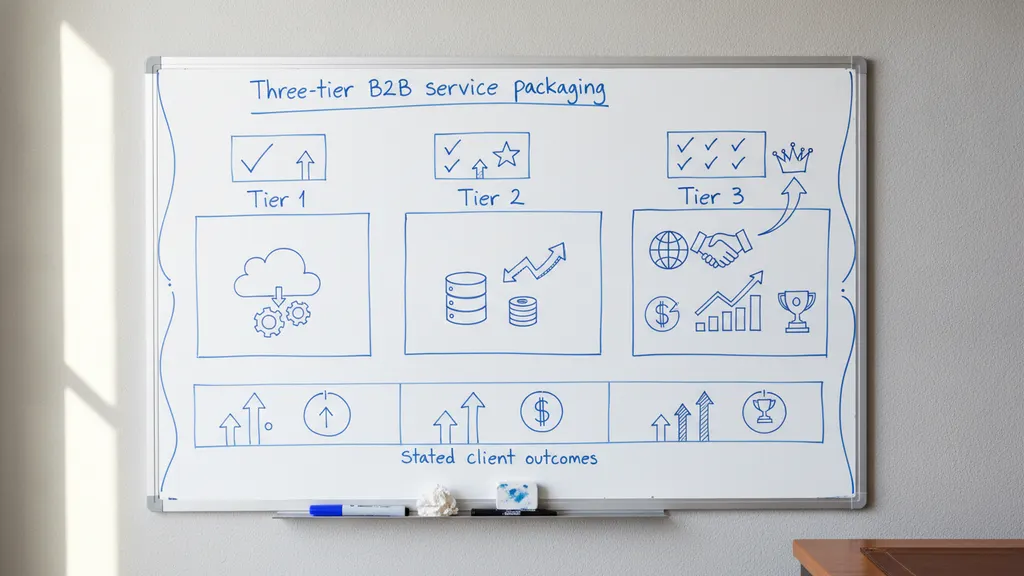
| Decision | Starter tier | Core tier | Scale tier |
|---|---|---|---|
| Buyer problem | Prove the approach works | Fix the system end to end | Run it as a standing function |
| Scope shape | Fixed, single workstream | Fixed, multiple workstreams | Rolling, planned quarterly |
| Outcome stated as | A decision or diagnostic | A working system | A managed result |
| Pricing logic | Flat fee, published band | Flat fee by scope unit | Retainer by capacity |
| Exit condition | Findings delivered | System handed over | Quarterly renewal |
When to use B2B service packaging instead of custom proposals
Package when the work repeats and the buyer's situation is recognizable inside a short call. Keep the custom proposal when the problem is novel, the stakeholders are still arguing about the goal, or the engagement depends on access you cannot confirm up front. Most firms need both, with a written rule for which one applies.
The honest test is frequency. If you have written near identical proposals three times, you are already running a package and paying a writing tax for it. Custom documents also hide pricing drift: the same work sold at three prices in one quarter is a packaging problem wearing a proposal's clothes. If proposals remain your main path, tighten them first with B2B proposal writing, then package what repeats.
There is a growth argument too. McKinsey's research on B2B buying behavior finds business customers increasingly expect a personalized experience across the buying journey, which sounds like a case against packaging and is not. Personalization that holds up at volume comes from a known starting shape plus a few deliberate choices, not from rewriting the offer each time. B2B service packaging gives you the shape to personalize inside.
How B2B service packaging improves sales conversations and delivery margins
Packaged offers change what the first call is about. Instead of scoping out loud, you are confirming fit against a known shape, which shortens the path to a decision and keeps the discussion on outcomes. Delivery benefits in parallel, because a repeated shape can be staffed, estimated, and improved between engagements.
Purchase ease is the mechanism. Gartner reports that buyers who find a supplier's information helpful are about 2.8 times more likely to experience a high degree of purchase ease. Clear packaging is how a firm supplies that information before anyone talks. Shorter, cleaner cycles follow the same logic described in shortening the B2B sales cycle.
Margin improves for unglamorous reasons. Known scope reduces rework, known staffing reduces idle senior time, and published boundaries reduce the free work that custom engagements absorb quietly. B2B service packaging also makes bad-fit deals visible early, which is far cheaper than discovering misfit in month two. Salesforce's State of Sales research tracks how much seller time disappears into non-selling work, and packaging takes back a slice of it.
What to test before you launch a new B2B services package
Test the words, the price logic, and the delivery load before you publish anything. A package that reads beautifully and cannot be delivered at the stated boundary is worse than no package, because it converts and then disappoints. Run it as a limited pilot with real buyers and real staffing first.
Four checks are worth running. Language: do buyers describe their problem the way your package title does, and does Semrush's keyword research data show people searching that phrasing? Comprehension: hand the one-page offer to someone outside the deal and ask them to explain it back. Price reaction: watch where buyers hesitate, not only whether they say yes. Delivery: run two engagements against the exact scope line and measure the overrun.
Then keep the loop running. Review won deals, lost deals, and overruns together each quarter, and change one variable at a time so you can tell what moved. B2B service packaging is not a launch, it is a standing practice, and the firms that treat it that way stop watching their margin drift back toward custom work.
Frequently asked questions
How do I know when my services are ready to package?
Look for repetition and recognizability. If your team has delivered substantially the same engagement three times, and you can identify the buyer's situation inside a twenty minute call, the work is ready. Also check that you can state one outcome the client cares about and one boundary you will hold. If either is missing, package the diagnostic step instead and sell the larger work afterward. B2B service packaging rewards firms that already have delivery discipline, so fix an unstable process before you advertise a fixed scope. Gartner's research on purchase ease is a useful reminder that clarity, not more choice, is what moves buyers forward.
Will packaging cost me money on larger deals?
Sometimes, and it is usually recoverable. Publish a top tier priced by capacity and a stated path for work outside the tiers, so a large buyer has somewhere to land instead of walking away. Keep a custom route for unusual engagements and write down the criteria for using it. The bigger risk runs the other way: unpriced custom work that absorbs senior time at no premium. McKinsey's growth, marketing and sales research describes business buyers expecting tailored experiences, which you can meet with configurable options inside a fixed frame rather than a blank page every time.
What do I do when a buyer wants something the package does not cover?
Decide in advance which requests are add-ons, which trigger a tier change, and which are a polite no. Write the add-on list down with its own scope and price logic so the answer takes a minute instead of a meeting. Say no when the request would break the boundary that makes the package deliverable, and explain why in terms of the client's result. Forrester's B2B research commentary notes that buyers value clear information over seller hand holding, and a firm boundary with a reason attached reads as clarity. Track every request, because repeated ones become your next tier.
Should I publish prices on my website?
Publish something, even if it is not a final number. A starting band, a typical range, or a plain explanation of how price is set all give a buyer enough to self qualify, which is what most of them are trying to do before they contact you. Hiding price does not protect margin, it filters out people who were ready to move. If competitive exposure worries you, publish the pricing logic and the minimum engagement rather than a full rate card. Salesforce's State of Sales report tracks how much buying activity now happens before a seller is involved.
What should I name my service packages?
Name it after the buyer's problem or the result, not your internal process. A title like Pipeline Diagnostic beats a clever codename, because the buyer has to forward it to people who were never on the call. Avoid metal tiers, Bronze through Platinum, which tell a buyer nothing about scope or outcome. Test the phrasing against real search demand before committing, since Ahrefs keyword research tools show which terms buyers actually type. Then keep the names stable for at least a year, because renaming resets the recognition you spent budget building.
How long does B2B service packaging take to show results?
Expect signal in one quarter and economics in two or three. Sales conversations change first, because a clear offer immediately changes what the first call is about. Close rate and cycle length move next, once enough deals have run through the new shape to compare. Delivery margin moves last, since it depends on two or three engagements finishing inside the stated boundary. Treat the first ninety days as a measurement period rather than a verdict, and change one variable at a time. Gartner's sales practice research is a good external check on whether your buying experience is getting easier.